
Mugapakkajataka
Mugapakkajataka
In the ancient and verdant land of Savatthi, a king named Supparaka ruled with a benevolent hand. His kingdom was a tapestry of lush forests, sparkling rivers, and fields ripe with grain. The people lived in peace and prosperity, their hearts unburdened by strife. Yet, even in this idyllic realm, a shadow could fall, not from external enemies, but from the subtle workings of ambition and the thirst for power.
The king had a son, Prince Bodhi, who was as handsome as he was intelligent. He possessed a keen mind and a brave heart, qualities that would have made him a fine successor. However, Prince Bodhi harbored a secret ambition. He yearned for the throne not just to serve his people, but to wield absolute power, to shape the kingdom according to his own will, unhindered by any counsel.
Unknown to the prince, the king, in his deep wisdom, perceived this burgeoning ambition. He understood that a kingdom could not thrive under a ruler whose primary motivation was self-aggrandizement. Therefore, he devised a plan, not to punish his son, but to guide him towards a truer understanding of kingship.
One day, the king announced a grand competition. 'To my brave warriors and noble citizens!' he proclaimed, his voice resonating with authority, 'I shall bestow the highest honor upon the one who can bring me the rarest and most exquisite bird in the world! A bird whose song is as pure as a mountain spring and whose plumage is more dazzling than any jewel.'
The court buzzed with excitement. Many sought fame and fortune, eager to impress their king. Prince Bodhi, too, saw this as an opportunity to prove his worth and gain favor. He gathered the finest hunters and explorers, offering them lavish rewards to embark on this quest.
Meanwhile, the king, in his private chambers, summoned a wise old hermit who lived in the nearby forest. This hermit, known for his profound understanding of nature and his ability to communicate with all living beings, was a trusted confidant of the king. 'Wise one,' the king implored, 'I have set forth a challenge for my kingdom. I seek a rare bird, but my true intention is to teach my son a lesson about the nature of true leadership. I need your assistance.'
The hermit, with a gentle smile, agreed. He knew that the king's heart was pure and his intentions noble. He spent days meditating, listening to the whispers of the wind and the rustling of leaves, seeking guidance from the natural world.
Prince Bodhi's hunters, armed with nets and traps, scoured the kingdom. They searched the highest mountains, the deepest jungles, and the most remote islands. They captured countless beautiful birds, birds with vibrant colors and melodious songs, but none met the king's exacting description. The prince grew increasingly frustrated. He pushed his men harder, his own ambition fueling their relentless pursuit.
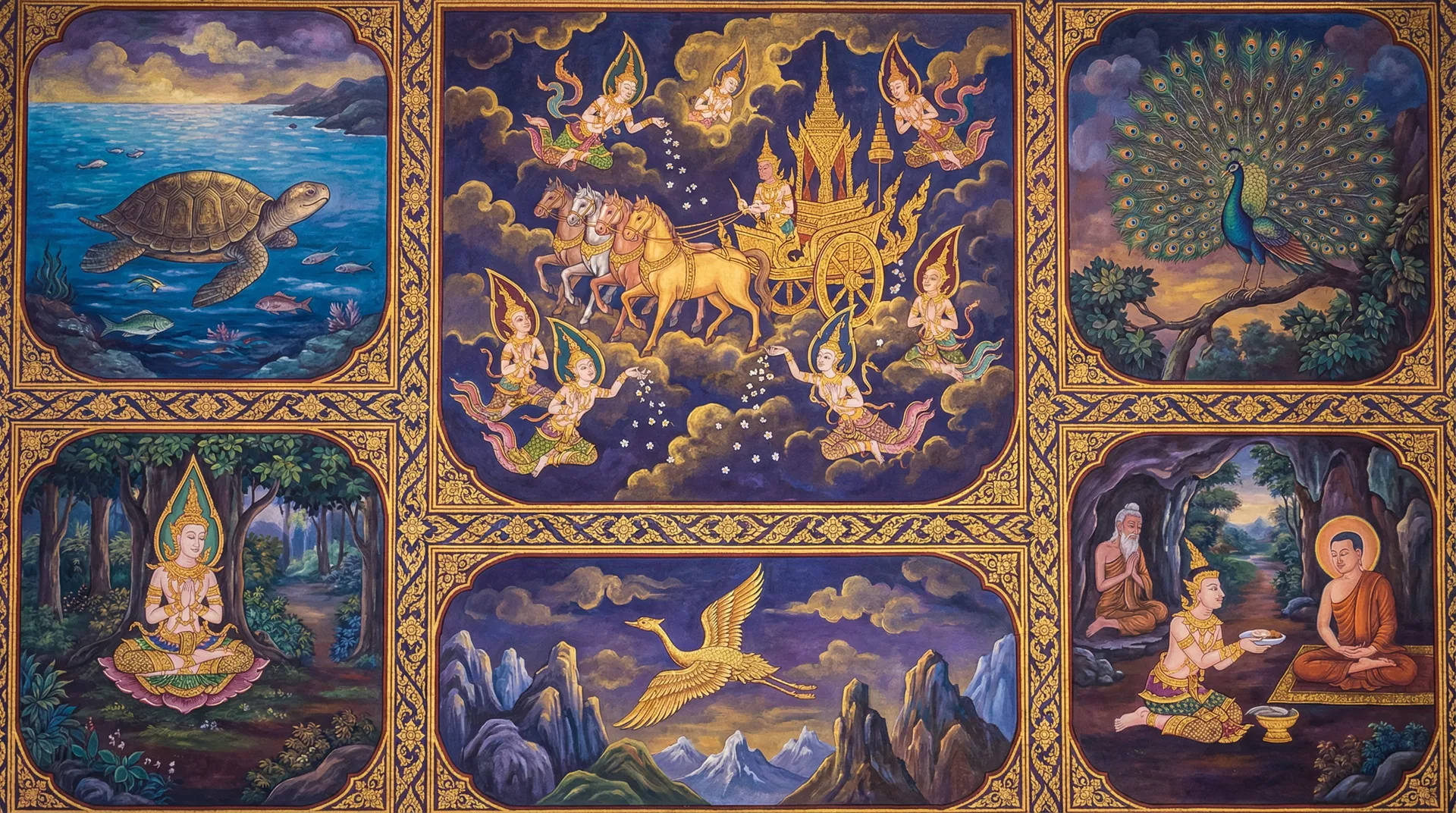
Finally, after weeks of fruitless searching, one of the prince's most seasoned hunters stumbled upon a peculiar sight. In a hidden grove, nestled amongst ancient trees, was a bird unlike any he had ever seen. It was small, seemingly unremarkable in its dull, grayish plumage. It did not sing with the grandeur of a peacock or the sweetness of a nightingale. It sat quietly, its eyes holding a deep, knowing gaze.
Intrigued, the hunter approached cautiously. The bird did not flee. He managed to capture it with a simple snare, marveling at its lack of resistance. He brought the bird back to Prince Bodhi, who, though initially disappointed by its plain appearance, was desperate to present something to his father. 'This is all we could find, my lord,' he said, his voice heavy with defeat. 'It is not what we hoped for.'
Prince Bodhi presented the bird to King Supparaka. The court gasped, not in admiration, but in confusion. The bird was indeed plain, its feathers ruffled, its form unassuming. King Supparaka, however, looked at the bird with a knowing smile. 'Bring it closer,' he commanded. He gently took the bird from the prince's hands and whispered something to it, a series of soft, melodic sounds that seemed to flow from his very soul.
To the astonishment of everyone present, the dull bird ruffled its feathers and began to sing. It was not a song of flamboyant trills or complex melodies, but a song of profound peace, a melody so pure and resonant that it seemed to touch the deepest chords of their hearts. The court fell silent, captivated by the exquisite, unadorned beauty of the song. The king then spoke, his voice filled with quiet authority, 'This, my son, is the bird you sought. Its beauty is not in its outward adornment, but in the purity of its spirit and the truth of its song.'
He turned to the hermit, who had quietly entered the hall. 'Wise one,' the king said, 'you have helped me demonstrate a vital truth. This bird, the Mugapakka, does not sing unless it is in a state of perfect peace and contentment. Its song is a reflection of its inner state. Just as this bird's song is not for show, a true ruler's strength is not in displays of power, but in the quiet strength of justice, compassion, and self-control.'
Prince Bodhi, humbled and enlightened, looked at his father with newfound respect. He understood that his ambition had blinded him to the true essence of leadership. The king continued, 'A ruler who seeks to dominate, who acts out of personal desire, will always be like a bird whose song is forced, discordant, and ultimately, hollow. True leadership, like the Mugapakka's song, arises from inner peace, wisdom, and a selfless dedication to the well-being of others.'
The prince bowed deeply. 'Father,' he said, his voice filled with sincerity, 'I have been foolish. I sought power for myself, but you have shown me the true meaning of ruling. I understand now that the greatest strength comes from within, from a heart dedicated to service and harmony.'
King Supparaka smiled and placed a hand on his son's shoulder. 'You have learned a valuable lesson, my son. May this understanding guide your path as a future leader.'
From that day forward, Prince Bodhi dedicated himself to mastering not the art of command, but the art of selfless service and compassionate governance. He understood that the most profound influence comes not from a loud decree, but from a quiet example, a song of peace that resonates from a heart at rest.
— In-Article Ad —
💡Moral of the Story
True leadership is not about external displays of power, but about inner peace, wisdom, and selfless service. The most impactful actions often come from a place of quiet strength and genuine compassion.
Perfection: Wisdom (Prajna) and Patience (Khanti)
— Ad Space (728x90) —
More Jataka Tales You May Enjoy
 401Sattakanipāta
Nimi Jataka
Nimi JatakaLong ago, in the ancient city of Mithila, ruled a just and virtuous king named Nimi. His ...
💡 True joy and lasting happiness come from living a life of righteousness and virtue, free from attachment and clinging to desires and outcomes.
 119Ekanipāta
Masa Jataka
Masa Jataka In a sprawling forest, where ancient trees reached towards the heavens and a thousand st...
💡 Patience, resilience, and unwavering leadership are crucial to overcome extreme hardship. Selfless compassion and the prioritization of the vulnerable are the hallmarks of true strength and lead to collective survival.
25EkanipātaThe Bodhisatta as a Swan
The Bodhisatta as a SwanIn the shimmering expanse of a celestial lake, where the water was as clear ...
💡 True compassion knows no bounds, and celestial beings are called to act when suffering is present, bringing salvation.
 256Tikanipāta
Kaccābarāva Jātaka
Kaccābarāva JātakaIn the ancient land of Mithila, where rivers flowed like silver ribbons and forest...
💡 The greatest strength lies in selfless sacrifice for the well-being of others.
274TikanipātaMuni Jataka
Muni JatakaIn the foothills of the Himalayas, where snow-capped peaks pierced the azure sky and anci...
💡 The greatest strength and truest conquest lie not in overcoming external forces, but in mastering oneself through inner peace, self-discipline, and wisdom.
242DukanipātaKusa Jataka
Kusa JatakaIn the ancient kingdom of Mithila, nestled amidst verdant plains and whispering bamboo fo...
💡 True nobility lies not in birthright, but in character, resilience, and unwavering integrity, especially when faced with betrayal and hardship.
— Multiplex Ad —